
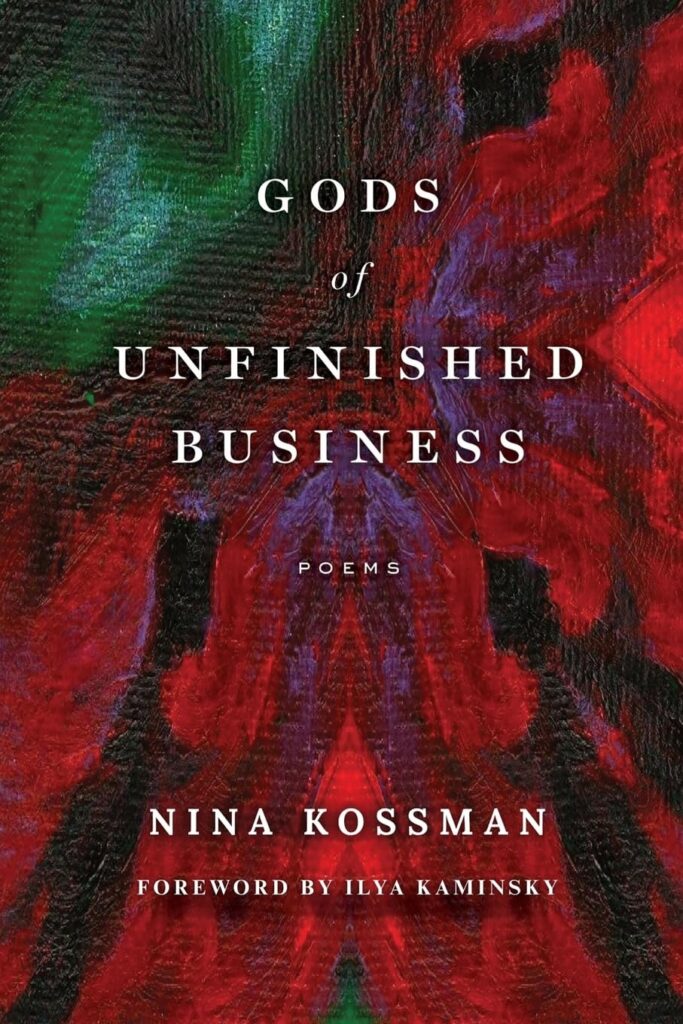
What is Nina Kossman’s God, and what kind of Unfinished Business are we about to get into, I wondered, opening this book of poems. “History Transformed into Myth,” the subtitle at the front of these pages warned, and I wondered what is history if not already a myth. That’s what I thought, getting started, yes–right before I learned that Kossman sent me these poems from a warzone, literally: the poet’s e-mail said she was in the occupied Ukraine at that time. And just like that, the mythological history, whatever that is, became a documentary fact. Facts take an interesting role in this collection of poems, actually: we begin with an echo of an ancient Akkadian text also taking place in a warzone, though of a very different kind. And, indeed, the myth comes forth. Or, rather, the myth is denied us (“What Ismul’s soul learned in the city of souls is never revealed”) only to be revealed as the pages turn…”
“When the mythological and personal meet, something transforms for this reader; perhaps that very “semblance of meaning in a meaningless world” comes to the surface. What is that meaning, you might ask. Perhaps it is awareness of how one isn’t alone, after all, and has never been alone on this planet, despite what humanity’s so-called “progress” seems so intent to insist on.”
-Ilya Kaminsky
“Kossman’s poems evoke Joyce’s characterization of history as a maze of nightmares that his alter ego, Stephen Dedalus, is trying to escape. The book opens in prehistoric Mesopotamia with “a faux re-creation of an ancient Akkadian text” on Ismul, the Boy Warrior. The poem is a long parable on the futility and ignobility of warring humanity. …Are these poems all gloom? Surprisingly not. Like all good poetry, the very act of their being written releases a certain unnamed hope. …Stephen Dedalus’ mythic namesake finally did escape his impossible maze. Tragically so, because myth is tragic. But he soared, if ultimately alone, into the freedom of the open air.”
—Art Beck, Your Impossible Voice
“The poet is … selflessly employed in an obscure task: to approach and embrace the inexplicable in their own language and preserve it in the language of complete strangers. Some poets, and Wallace Stevens and Paul Celan come to mind, even contain whole novels in single lines of their spotless verse. This is, it seems to me, also the rather rarefied job description of Nina Kossman, whose new collection of poems, Gods of Unfinished Business, sheds a gentle light on the subtle path leading to a greater appreciation for the inexplicable.”
—Donald Brackett, “Selflessly Employed: Gods of Unfinished Business”
“These are small hymns to desolation; the gods have left without a trace of irony. What Kossman sometimes pulls out of this desolation are cultivated memories, and the building of an interior world that is a fortress against the modern nihilism banging at the gates, where creation might still have a chance of breaking ground.”
—Edward Farrell